
From Digital to Tabletop
Game Design Research · Bachelor’s Thesis · MDA Framework
How can a game preserve its identity when moving to a completely different medium?
This research project explores the relationship between game systems and player experience through a comparative analysis of XCOM: Enemy Unknown and XCOM: The Board Game.
Using the Mechanics–Dynamics–Aesthetics (MDA) framework, I examined how two games with different rules, systems and player interactions can create similar emotional experiences.
My role: Independent research, game analysis, comparative study and synthesis of findings.
The Design Question
Can two games with fundamentally different systems deliver a similar player experience?
Digital games can support complex tactical combat, persistent progression and extensive campaigns. Tabletop games rely on physical components, direct player interaction and different approaches to pacing and decision-making.
The challenge was to identify which aspects of the XCOM experience depended on its original mechanics, and which could be recreated through systems better suited to a different medium.
Methodology – MDA
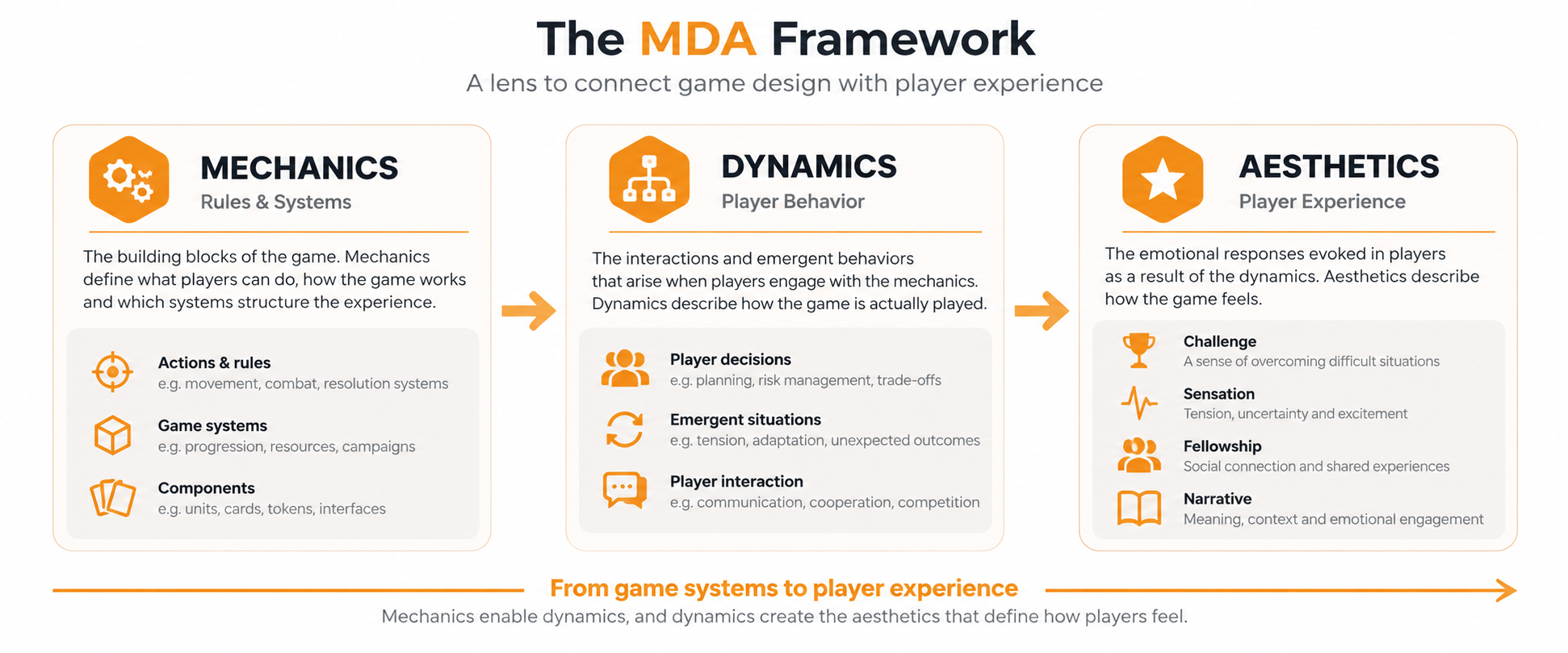
To investigate this question, I used the Mechanics–Dynamics–Aesthetics (MDA) framework, examining each game through three interconnected layers:
Mechanics: The rules, systems and actions available to players.
Dynamics: The behaviors, decisions and interactions that emerge when players engage with those systems.
Aesthetics: The emotional experiences created through play, such as challenge, tension, narrative engagement and cooperation.
I analyzed each XCOM game independently before comparing the results, focusing on how different mechanics and dynamics could support similar player experiences.
Comparative Analysis
Different Mechanics
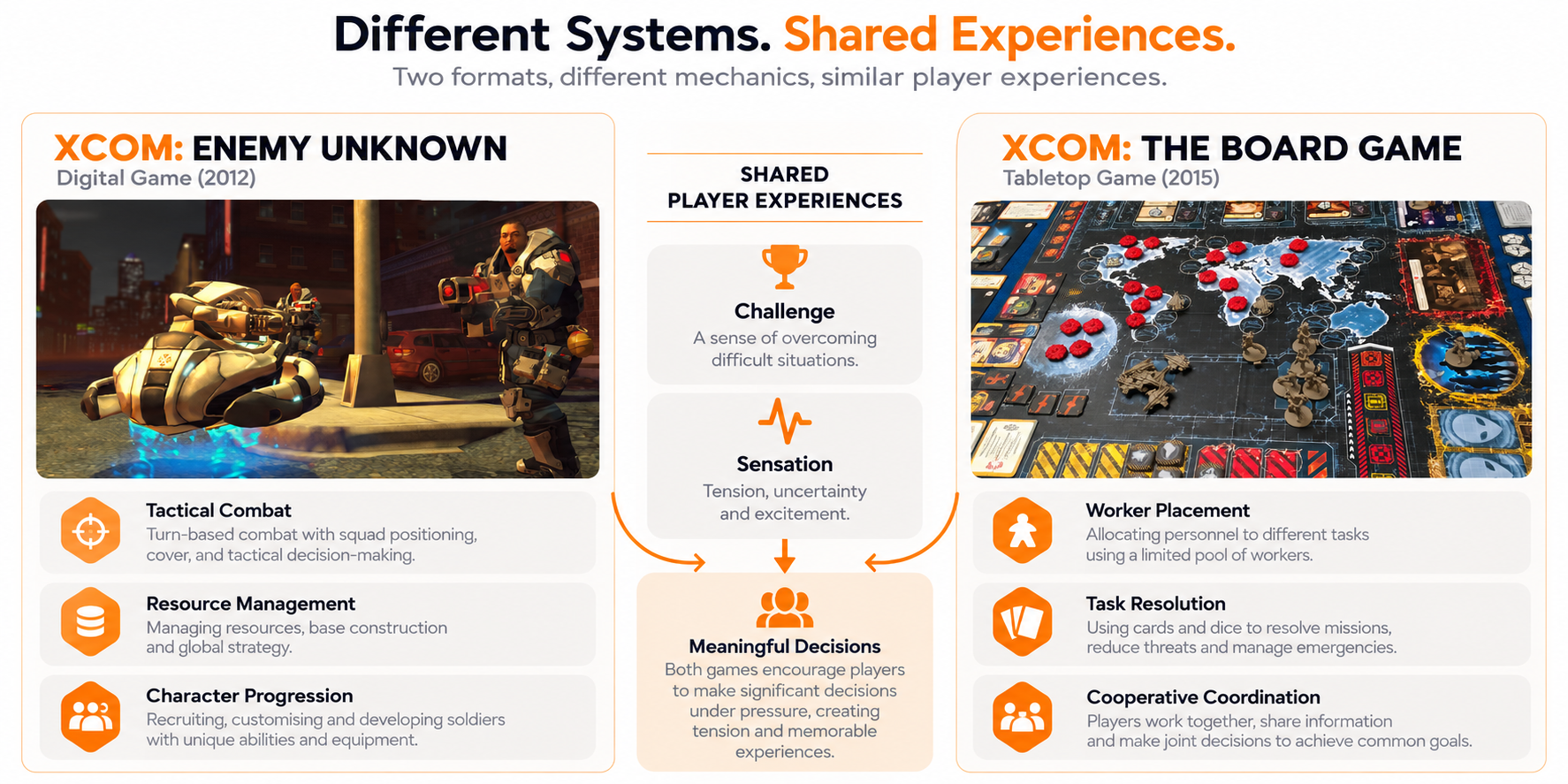
XCOM: Enemy Unknown builds its experience around tactical combat, resource management and character progression.
XCOM: The Board Game uses phases, worker and token placement, task resolution, cards and economic decisions.
Although both games belong to the same franchise, their mechanics differ substantially, reflecting the strengths and limitations of their respective formats.
Different Dynamics
Both games create pressure through limited resources, difficult decisions and threats that demand attention.
In the digital game, players focus on individual tactical decisions, squad management and long-term progression.
In the tabletop adaptation, communication, cooperative coordination, risk management and shared responsibility become central to the experience.
The systems are different, but both encourage players to make meaningful decisions under pressure.
Shared Player Experiences
The MDA analysis identified different aesthetic priorities in each game:
XCOM: Enemy Unknown: Challenge, Sensation and Narrative.
XCOM: The Board Game: Fellowship, Challenge and Sensation.
Challenge and Sensation emerge as the strongest shared experiences. Both games create tension, uncertainty and a sense of overcoming difficult situations, despite using different mechanics to achieve them.
The tabletop game also introduces a stronger emphasis on Fellowship through direct communication and cooperative decision-making.
Key Findings
The comparison revealed that games with substantially different mechanics can preserve recognizable aspects of the same player experience.
Both versions of XCOM maintain Challenge and Sensation as central elements, creating tension through uncertainty, limited resources and difficult decisions.
However, each format emphasizes different experiences. The digital game supports longer-term narrative engagement, while the tabletop adaptation places greater importance on cooperation and communication.
The companion app in the board game also contributes to time pressure, reinforcing the tension and coordination required from players.
Design Takeaways
This research reinforced the importance of designing around player experience rather than focusing exclusively on individual mechanics.
When adapting a game to a new format, the process should begin by identifying the experiences that define the original, understanding the systems and behaviors that produce them, and rebuilding those experiences using mechanics suited to the destination medium.
Core takeaway: Preserving a game’s identity does not necessarily mean preserving its rules.
This experience-centered approach is applicable beyond adaptations, providing a useful perspective for designing new systems, evaluating features and understanding how mechanical changes influence player behavior.
Full Research
Experiencia de juego: Análisis del videojuego y el juego de mesa de XCOM a través del modelo MDA
Bachelor’s Thesis — Juan Carlos Marcos de León Castro
The complete research is available in Spanish and includes the theoretical framework, detailed analysis of both games, comparative findings and bibliography.